Subcategories
-

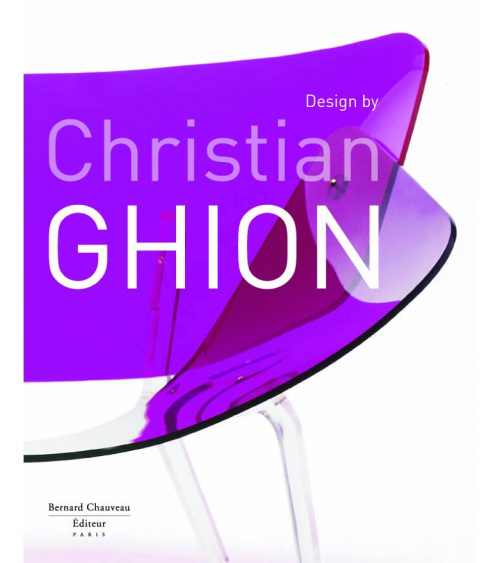
Christian Ghion -...
An exhaustive appraisal of designer Christian Ghion's work. This book examines his numerous fields of intervention (design of objets, furniture, architecture and interior design...). It shows the original path pursued by this ex-pupil of Philippe Starck. His talent and creativity have enabled him to collaborate with the greatest names (editors : Capellini, Sawaya & Moroni, XO), (personalities: Pierre Gagnaire, Chantal Thomass, Jean-Charles de Castelbajac.)
Text in French & English by Barbara Poirette. Preface by Pierre Doze. -

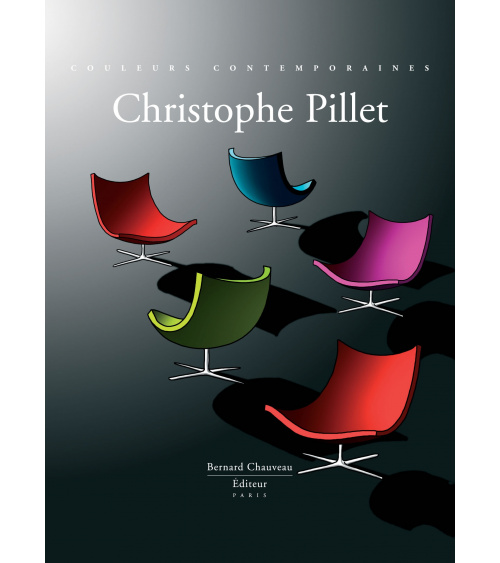
Christophe Pillet
A fifteen years period of creation by the French designer Christophe Pillet : plans, drawings, sketches, for design, architecture or design. Text by Olivier Reneau in English.
-

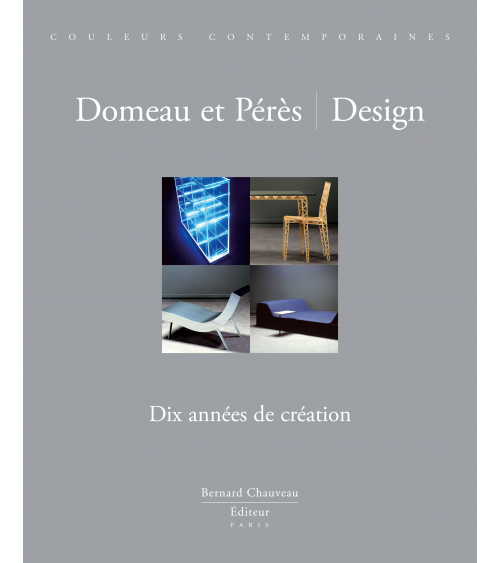
Domeau & Pérès - Design
This book presents a ten year collaboration in furniture creation between the French creators Domeau and Pérès, and some well-known designers. Limited edition of 500 numbered portfolios, with 12 hand-colored stencilled illustrations. Book award Paris 2005.
-

L'expérience de la...
The Ceramic Experience is the result of a fifteen year’s exceptional creative boiling of more than 60 artists in the domain of contemporary ceramic, hosted by the Center of research for ceramics and enamel applications in art and design in Limoges (France). Texts in English. The first 200 books are edited with a set of 4 plates especially designed by the rewarded French creator Pierre Charpin.
-

Roland Daraspe - De la...
Roland Daraspe, as a recognized Master of Art and goldsmith, shows us here his contemporary work of art inspired by submarine and vegetal life. A limited edition of 100, presented in a deluxe casket, comes with exclusive original massive silver “leaf”, numbered and hallmarked.
-

Christian Jaccard -...
This monograph presents a set of works and interventions, some of them new, by artist Christian Jaccard. It is published for the exhibitions dedicated to him from June 2011 to January 2012 in the Domaine de Kerguéhennec, in the Villa Tamarisk (La Seyne-sur-Mer) and in the Centre of Contemporary Art in Colmar. The text by philosopher Dominique Chateau gives a complete overview of the work of the artist. Between "feux et noeuds" (fire and knots), Energies dissipées invites us to meditate on this original style of work, to discover it in the traces and imprints which every intervention by the artist leaves on the support he has chosen.
For the limited edition the artist has specially created a number of unique combustions with slow fuse on 250g Arches vellum paper. -

François Rouan - La...
François Rouan is one of those who have seen Matisse. The paper cut-outs of the years 1965-1966 bear witness to this. Everything began with these works on paper, coloured, cut-out, intertwined, folded on themselves, braided together. But already, the collage was to serve more than simply quantifying colour. For Rouan, it became a tool - or better, a model - to tear away the modernist plan from the temptation of smoothness, from the simplifying and minimalist purity.
Since those first papers, through the “tressages” of the years 1969-1970, those ever more complex braided fabrics woven over and under, inside and out, in three or four wefts, the paint has surfaced, literally. The field of the picture splits and opens, producing a thickness of furrows and folds that let the body through.
Today, the painting work of François Rouan incorporates these same principles of “tressage”, always opening the plane of the picture to more corporality, affirming realities in the roughness, making emerge the presence of a being, of figures, not at once recognizable as such, but which are incorporated within the substance of the work.
The book "La découpe comme modèle" confronts these two sequences of Rouan’s painting work now separated by forty years : that of the years 1966-1970, and more recently, that of the years 2007-2011.
Texts by Bernard Noël and Isabelle Monod-Fontaine. -

La Tourette, Modulations
During his stay in the Dominican Monastery of La Tourette – the last major work of French architect Le Corbusier - photographer George Dupin disclosed a set of unseen snapshots, the results of a personal tour of the monastery. George Dupin is a follower of Lucien Hervé (a photographer in close contact with Le Corbusier) and offers a vision of the convent that unveils overviews and original details (furniture, atrium, hallways…).
Also for this occasion, the works of Alan Charlton, an artist invited to La Tourette, are exhibited in the convent during Lyon’s Biennale of Contemporary Art taking place from September 10th to November 18th 2011.
A silent dialogue emerges between the architect’s work and the artist’s. -

Guillaume Bardet -...
Between 21 September 2009 and 20 September 2010, designer Guillaume Bardet composed a drawing of a personal object every day for a year. As an extension of this experience, the following year he brought these drawings to life with the help of a group of potters from the Dieulefit area (Drôme, in the south of France).
The idea of creating 365 deeply personal objects over the course of a year was intended to intensify these two exciting stages in the process almost to the point of insanity. By producing a new item each day, Bardet resolved to experience the transformation of the creative process, in heightened form as it were, and consequently to discover a new formal artistic alphabet... in other words seeking a means to extend the boundaries of his expression in order to explore its depths more fully.
Although he chose to work with clay (earthenware, sandstone and porcelain) as his one and only medium in which to produce all 365 objects, this was not simply because Guillaume Bardet resides in Dieulefit, an area famous for its pottery and ceramics; as a young man, he had done a lot of clay modelling and it was this medium that enabled him to fully grasp and take on board his love of form.
After several months shut away in his studio, Guillaume Bardet went to meet a group of some 20 potters, sensing that their working practices would nurture his own, and vice versa. And indeed, his perspective did transform their creative methods, just as their expertise enhanced his own.
Now that the 365 pieces are nearing completion, this catalogue stands out as an indispensable record tracing the stages of this titanic project and ensuring a wide distribution of this adventure, which was both personal and artistic and for an entire year bound the fortunes of Guillaume Bardet with a dozen pottery studios.
Four exhibitions are scheduled, in 2012 – 2013, presenting the entire collection Guillaume Bardet's creations: - 24 January to 26 March 2012, at the Cité de la céramique in Sèvres - 29 April to16 September 2012, at the Grand Hornu Images in Belgium - October 2012 to January 2013, at the Château des Adhémar contemporary art centre in Montélimar, and at the Maison de la céramique in Dieulefit - March 2013 to June 2013, at the Mudac in Lausanne, Switzerland
This 456 page book resembling a tear-off calendar will present the entire collection of Guillaume Bardet's creations. The decision was made to display the various fruits of his daily output, following on page by page, (including vases, jars, stools, folded paper creations, table-top items and lamps) with the date as a point of reference on each page (as a caption) and including the characteristics of each object. This book will serve as a catalogue, accompanying each of the exhibitions.
In all 400 illustrations are planned for inclusion in the book, to be produced by Pierre Olivier Deschamps. Three authors were approached to write the texts: Lorette Nobécourt, Catherine Geel and Claude Eveno (their biographies are featured below). The texts have been translated into English. The c-album agency, headed by graphic designer Laurent Ungerer, is responsible for designing the layout and creating this publication.
Book published with financial backing of the Centre national des arts plastiques (publishing financial backing). -
Christian Bonnefoi -...
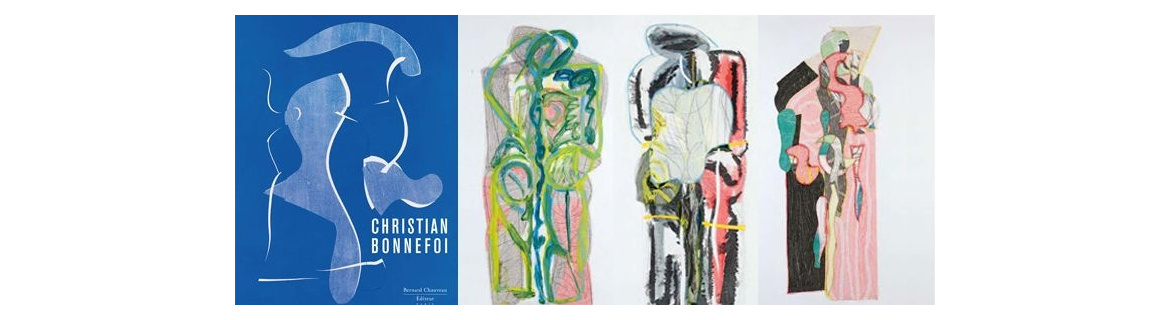
For nearly forty years, Christian Bonnefoi’s work has stood in a very special place on the painting scene and, more generally, in the history of contemporary art. The artist has developed a visual language of his own, using painting, drawing, collage and installation, mixing art forms and references.
Bonnefoi’s distinctive approach is his personal use of collage, resulting in a surface that becomes the subject matter of the work without any representation, suggestion or narrative: a way of stressing the prevalence of process and composition in the final outcome. The artist dates the origin of his artistic approach back to his discovery of Matisse’s “backs” shown in Paris in 1970 at the Grand Palais exhibition: “Henri Matisse, l’exposition du centenaire.” Bonnefoi’s first “Backs” would come out four years after this event and since then have appeared as recurrent elements in his work.
The limited edition comes with an original silk print created especially for this catalogue by Christian Bonnefoi in 25 copies signed and numbered by the artist. -
Auguste Herbin
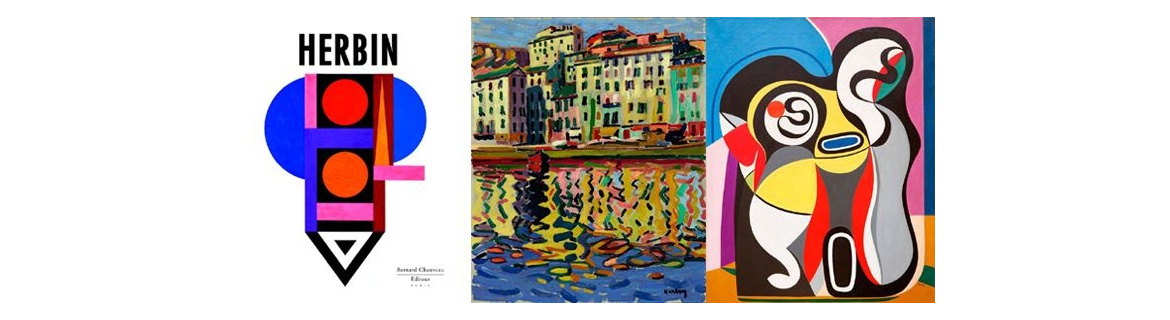
Along with Matisse, Auguste Herbin founded the Museum of Le Cateau-Cambrésis, to which he donated twenty-two works of art in 1956. Like Matisse, Auguste Herbin was born in a cloth-weaving milieu. Auguste Herbin is considered one of the undisputed masters of colour. Auguste Herbin led an active role in the great Fauvist and Cubist revolutions, and after the First World War, he became one of the main protagonists in the great movement toward Abstractionism, in particular with “Abstraction – Creation” and “New Realities”. A founder of the Abstract art movement in France, AugustenHerbin left an outstanding mark on his century.
This exhibition is dedicated to Auguste Herbin. It will group a selection of about 250 significant works, from private collections and major American and Western European museums, around the Matisse Museum collection, which is enriched year by year, and is now the world’s largest collection of this artist’s work.
French texts by: Claire Berchiche, Geneviève Claisse, Patrice Deparpe, Christian Derouet, Nathalie Gallissot, Serge Lemoine, Jacqueline Munck, Dominique d’Orgeval, Arnaud Pierre, Dominique Szymusiak. -
Derrière le visible -...
“Light has this unique quality, of being at once material and immaterial… light speaks”.
As an invited artist this year at the Convent of La Tourette, ÉRIC MICHEL conducts research on light, a study that harmonizes well with that of Le Corbusier, the architect, for whom light, like concrete, is a material. This encounter drove Éric Michel, light bearer (passeur de lumière), to create a series of luminous neon installations especially for the Convent. They play on the frontier of the material and the immaterial, conveying us along a path that interrogates our relationship to reality.
After several sojourns at the Convent, FRANCK CHRISTEN (resident photographer invited conjointly with Éric Michel) brings us photos showing great restraint and sensitivity, and evoke – beyond the life of the friars – all the complexity of a work on images set against such a building.
Texts by Rébecca François, Éric Michel, Damien Sausset, Brother Marc Chauveau. -

Philippe Favier - Noir
What characterizes Philippe Favier’s work, built up over a couple of decades, is doubtless its consistent inventiveness and the liberty he accords to upsetting the images he initiates. In our society, given to labeling, it’s a bit tricky to appear at each exhibit with a brand-new look… But for more than thirty years, and after three retrospectives (one of which was held at the Jeu de Paume museum), it is plain to see, that with an undeniable coherence, Favier has succeeded in creating one of the richest and most original bodies of work of his generation.
The vocation of the Maison européenne de la photographie is to show works that “turn” around the medium of film. In the four halls consecrated to that, all the works presented (about one hundred) adhere to this principle. For someone too easily pigeonholed in the “painting aisle,” it is not without a little mischievousness that he is happy to present, for the first time together, his “photographic” works... -

Titus-Carmel -...
Gérard Titus-Carmel was born in 1942 in Paris. He lives and works in Oulchy-le-Château in France. From 1958 to 1962, he studied at the Ecole Boulle in Paris, in the printmaking and jewellery studios, and since then has devoted himself exclusively to drawing, painting and writing.
His work quickly became organized into suites and series, each dated and ‘closed’. Their titles, adjoined, tell a long story of loss leading to the edge of emptiness and absence. Then followed suites of drawings themed around dislocating and breaking, deconstruction and splicing. These all linked to the heart of a body of work whose conceptual and graphic investigations interpenetrate – work that he pursues, moreover, by "illustrating" a large number of works by poets and writers.
Since the early 70s, Gérard Titus-Carmel has worked series after series around a theme or an object that he creates himself before drawing or painting it.
In his surprising compositions, he recreates movement via streaks and hatch-marks in graphite, demonstrating considerable artistic assurance.
Gérard Titus-Carmel’s first solo exhibition took place in 1964. From these first exhibitions in the 60s, his paintings, drawings, lithographs and etchings revealed a passion for literature, echoed in the titles and dedications of his paintings.
Le tirage de tête (édition limitée) de cet ouvrage est constitué d'une peinture originale réalisée à la main par l'artiste Gérard Titus-Carmel. Estampage réalisé à la main et à la peinture acrylique directement par l'artiste. Chaque exemplaire est unique.
30 originaux disponibles. -
Anne et Patrick...
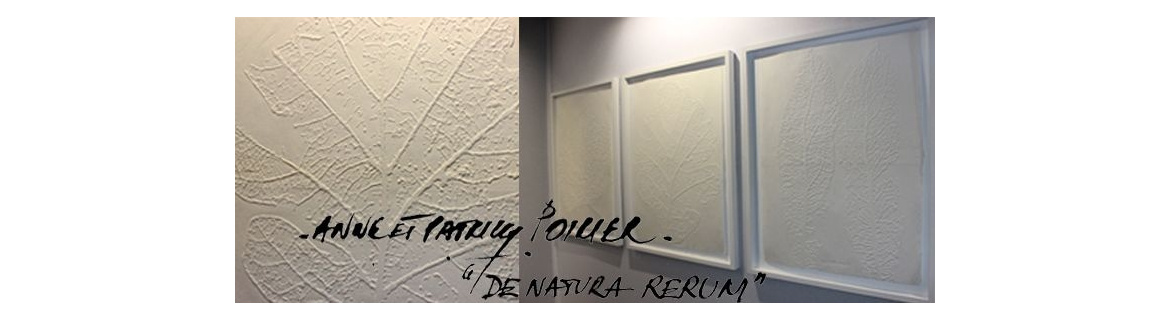
Anne and Patrick Poirier, inspired by the special tension felt at Le Corbusier’s masterpiece, the Convent of La Tourette, between landscape and fulfilled architectural utopia, have created a collection of works for the occasion, along with recent pieces. Composed of herbariums, drawings, photographs and models, where real places mix with dreamlike landscapes, these pieces reveal imaginary ruins and archaeological fragments. In this manner, they create a dialogue with the place, “tinged with the whiteness of the walls.”
For each exhibition, a photographer is invited for a residency at La Tourette. In 2013, they celebrated the convent’s restoration after six years of work. The light in the convent has been restored to the original, contrasting with the rough precast concrete, and emphasizing the architectural lines. Lazlo Horvath’s excellent photographs reveal the convent’s beauty.
The text of Le Corbusier’s tour during the inauguration is published here in French and in English to accompany this visit in pictures. -
Fabrice Hyber -...
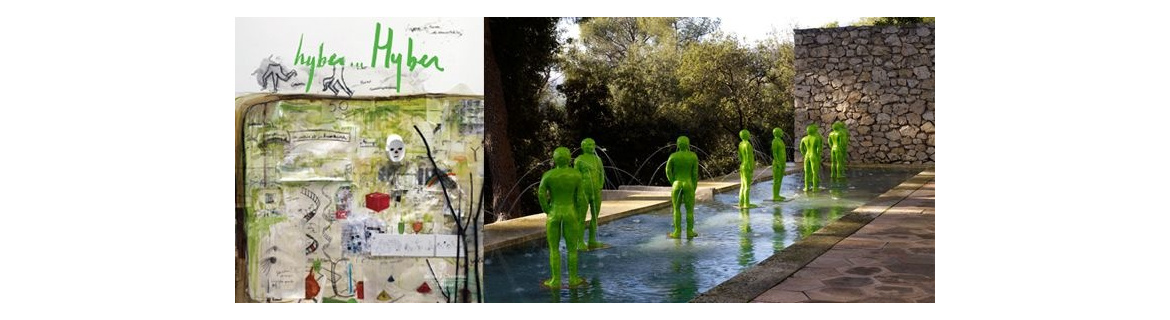
Fabrice Hyber keeps on rocking contemporary art with his POF (prototypes of functioning objects) or his unclassifiable exhibitions that transform museums into supermarkets or hairdressing saloons.
This book brings a hundred or so drawings that were especially created for the exhibition: an authentic user’s guide to understand the development of his practice.
The artist plunges us into a world functioning through hybridization, mutation, establishing links between varied forms, endlessly connecting with society and politics…
This work also contains the important statements of his last exhibitions (Palais de Tokyo, Mac/Val, Maeght Foundation, Institut Pasteur).