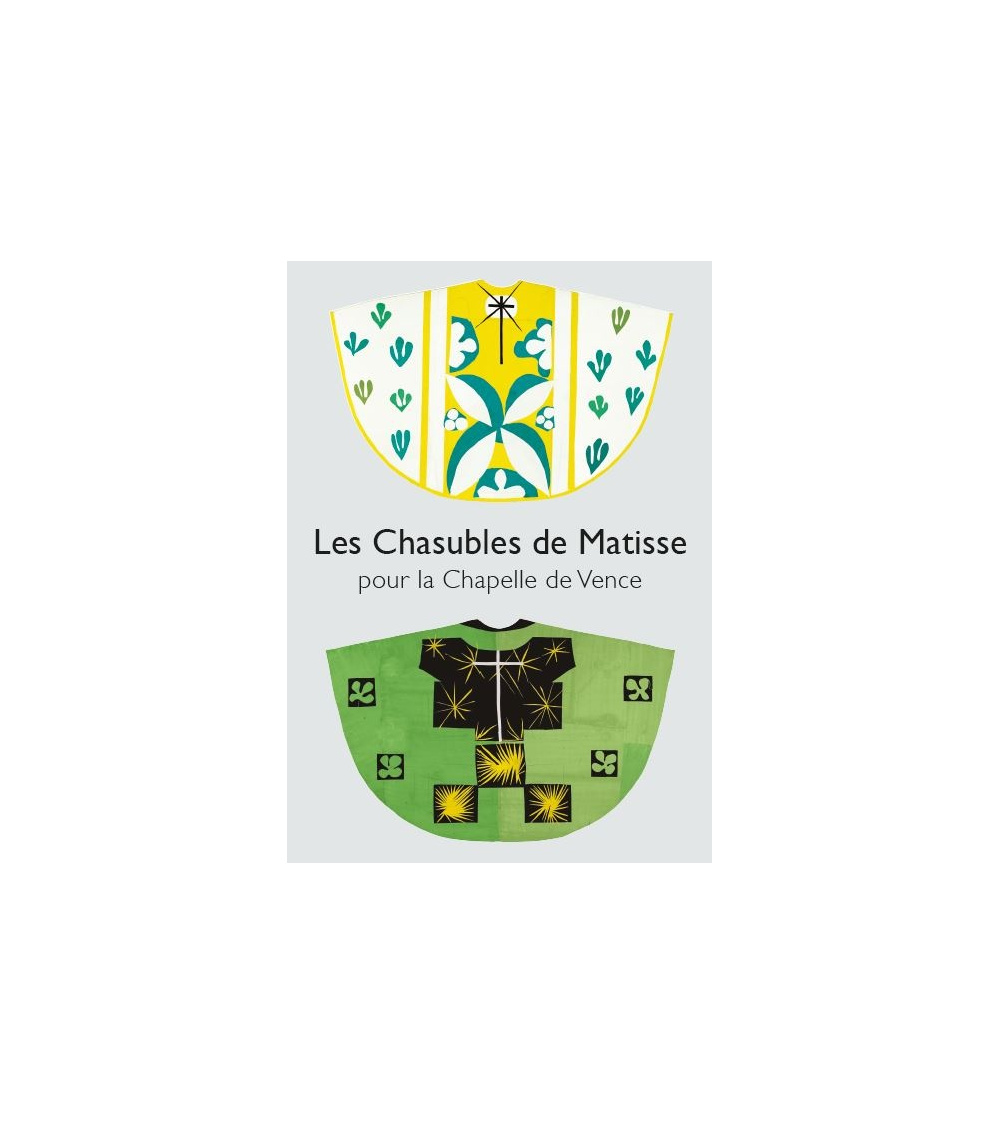
This books present a set of unpublished creations of Matisse.
Between 1950 and 1954, Matisse entirely dedicated himself to the creation of the Vence Chapel (Alpes-Maritimes, France). Result of a lifetime of work, it is considered a total work of art. Matisse designed every detail of this place of prayers and contemplation: architecture, stain glass, wall ceramics, furniture and liturgical vestments. Matisse even created a series of cutout gouaches chasuble models. They were later made in fabric and used during religious services. For the creation of these chasubles, Matisse had to work around a preexisting model and six mandatory colors from the catholic tradition with precise symbolic purposes:
- White is used for the main Christian celebrations: Christmas, Easter, the Ascension and the Assumption;
- Green, symbol of Redemption and Hope, is used over half of the year;
- Red, the color of fire, is used during Passion, Pentecost, the Solemnity of the Apostles and all the martyrs;
- Purple refers to periods of penitence, the Advent and Lent;
- The pink chasuble is used only two Sundays a year, during the Advent and Lent;
- Black is used for burial services and Ash Friday, the anniversary of the Christ’s death.
These chasubles are priest robes, but they also belong to fashion design, which Matisse was always passionate about. Christian Dior came to see the chasubles and insisted on how “haute couture” they are…
Data sheet
Specific References
Henri Matisse was born December 31, 1869, in Le Cateau in northern France. Over a six-decade career he worked in all media, from painting to sculpture to printmaking. Although his subjects were traditional—nudes, figures in landscapes, portraits, interior views—his revolutionary use of brilliant color and exaggerated form to express emotion made him one of the most influential artists of the 20th century.
In his later career, Matisse received several major commissions, such as a mural for the art gallery of collector Dr. Albert Barnes of Pennsylvania, titled Dance II, in 1931-33. He also drew book illustrations for a series of limited-edition poetry collections.
After surgery in 1941, Matisse was often bedridden; however, he continued to work from a bed in his studio. When necessary, he would draw with a pencil or charcoal attached to the end of a long pole that enabled him to reach the paper or canvas. His late work was just as experimental and vibrant as his earlier artistic breakthroughs had been. It included his 1947 book Jazz, which placed his own thoughts on life and art side by side with lively images of colored paper cutouts. This project led him to devising works that were cutouts on their own, most notably several series of expressively shaped human figures cut from bright blue paper and pasted to wall-size background sheets (such as Swimming Pool, 1952).
In one of his final projects, Matisse created an entire program of decorations for the Chapel of the Rosary in Vence (1948-51), a town near Nice, designing stained-glass windows, murals, furnishings, and even sacred vestments for the church’s priests.
Matisse died on November 3, 1954, at the age of 84, in Nice. He was buried in nearby Cimiez. He is still regarded as one of the most innovative and influential artists of the 20th century.